Summary: Key Takeaways for NDA Success
- Analytical Method Lifecycle CMC is a critical regulatory expectation during NDA review, not a theoretical framework.
- FDA reviewers assess analytical methods as living systems, not static validation reports.
- Poor lifecycle control is a frequent root cause of Information Requests (IRs), Complete Response Letters (CRLs), and late-stage delays.
- Method robustness, ongoing performance monitoring, and change control directly influence approval timelines.
- Aligning Analytical Method Lifecycle CMC with ICH Q8, Q9, Q10, and Q12 significantly strengthens NDA defensibility.
- Lifecycle documentation enables faster responses to FDA queries during filing and review.
- NDA success depends on traceability, scientific rationale, and continuous verification, not re-validation alone.
Introduction
Analytical Method Lifecycle CMC plays a critical role in NDA approval by showing FDA reviewers that analytical methods are well controlled, continuously monitored, and suitable for their intended regulatory purpose throughout the product lifecycle. This approach ensures that analytical results used for quality decisions remain reliable even after submission and approval.
During NDA review, analytical methods are not evaluated solely based on whether validation criteria were met in the past. Instead, FDA assesses them as risk-managed systems that directly influence product quality, patient safety, and long-term manufacturing reliability.
This article explains how Analytical Method Lifecycle CMC supports NDA approval, reduces regulatory risk, and aligns with current FDA expectations. It also highlights how lifecycle thinking improves review efficiency and overall inspection readiness.
Explore Our Full Suite of Services: Chemistry, Manufacturing, and Controls (CMC) Services
Why Analytical Method Lifecycle CMC Is Scrutinized During NDA Review
FDA closely reviews Analytical Method Lifecycle CMC to ensure that analytical data used for release testing, stability studies, and specifications will remain reliable after approval. Reviewers must be confident that commercial manufacturing data will be consistent with what was submitted in the NDA.
At this stage, FDA is not focused on whether a method passed validation once. Instead, they evaluate whether the method can perform consistently over many years, across different analysts, instruments, laboratories, and sites.
Lifecycle oversight demonstrates that variability sources are understood, risks are controlled, and corrective actions are clearly defined. Without this level of control, FDA may question the long-term reliability of critical quality data.
Ensure Compliance for Your Submission: Expert CMC Services for IND and NDA
What FDA Reviewers Actively Look For
FDA reviewers assess whether method variability is scientifically understood and controlled across the full operating range. They expect critical parameters to be selected based on data and understanding, not historical practice.
Robustness under routine laboratory conditions is a key focus. FDA wants evidence that small, expected variations in conditions do not compromise accuracy, precision, or data integrity.
Reviewers also look for a clear connection between method design, validation strategy, and ongoing performance monitoring. These components should form a logical lifecycle story rather than disconnected activities.
Risk-based justification for method parameters and acceptance criteria is carefully evaluated. Weak or missing justification often leads to IRs or additional data requests.
Failure to demonstrate effective lifecycle control frequently results in analytical IRs, requests for re-validation, approval delays, or CRLs. These outcomes are usually preventable with proactive lifecycle planning.
Understand Review Expectations: Inside the FDA Chemistry, Manufacturing, and Controls Review
How Analytical Method Lifecycle CMC Reduces NDA Information Requests (IRs)
A strong Analytical Method Lifecycle CMC framework reduces NDA IRs by providing clear scientific rationale instead of reactive explanations. FDA reviewers can easily follow why analytical decisions were made and how risks are managed.
Many IRs are issued not because data is missing, but because the reasoning behind analytical choices is unclear or poorly documented. Lifecycle documentation fills this gap effectively.
When method design, robustness, and monitoring strategies are clearly described, reviewers spend less time seeking clarification. This leads to smoother review cycles and fewer interruptions.
Analytical Method Lifecycle CMC shifts NDA responses from opinion-based narratives to data-driven conclusions that withstand regulatory scrutiny.
Avoid Common Pitfalls: Addressing CMC Deficiencies in IND and NDA Submissions
Lifecycle Elements That Prevent IRs
| Lifecycle Element | NDA Reviewer Expectation | Regulatory Impact |
|---|---|---|
| Method design rationale | Clear explanation of parameter selection | Fewer clarification requests |
| Robustness studies | Evidence of method tolerance | Reduced re-testing demands |
| Control strategy | Defined system suitability logic | Faster review cycles |
| Performance trending | Ongoing method verification | Confidence in commercial readiness |
Together, these lifecycle elements give FDA confidence that analytical methods are predictable, controlled, and sustainable over time.
Analytical Method Lifecycle CMC and Method Validation Strategy Alignment
Analytical Method Lifecycle CMC strengthens NDA approval by aligning validation depth with method risk and intended use. This approach reflects FDA’s expectations for scientifically justified validation strategies.
FDA no longer expects identical validation requirements for all methods. Instead, they expect validation to reflect the method’s role in ensuring product quality and patient safety.
Lifecycle-based validation ensures that high-risk methods receive appropriate scrutiny, while low-risk methods are validated efficiently. This balance helps maintain quality without unnecessary burden.
By applying risk-based validation principles, sponsors demonstrate strong regulatory understanding and analytical maturity.
Optimize Your Methodology: Analytical Method Development for IND and NDA
Lifecycle-Driven Validation Advantages
Lifecycle-driven validation avoids over-validating low-risk methods and allows teams to focus resources where they are most needed.
It strengthens validation of impurity methods, stability-indicating assays, potency tests, and bioassays, which face higher regulatory scrutiny.
This approach supports acceptance criteria that are scientifically justified and based on method capability rather than arbitrary limits.
Overall, lifecycle-driven validation aligns with FDA expectations and supports efficient NDA review with fewer scientific gaps.
How Analytical Method Lifecycle CMC Supports NDA Stability Commitments
Analytical Method Lifecycle CMC ensures that stability methods remain reliable throughout long-term and accelerated studies used to justify NDA shelf-life claims. Stability conclusions are only as strong as the methods that generate the data.
FDA places high importance on stability data integrity because it directly impacts patient safety and product performance over time.
Lifecycle oversight helps identify gradual method drift early, before it affects reported results or regulatory decisions.
By maintaining consistent method performance, sponsors reduce the risk of FDA questions related to shelf-life justification.
Secure Your Shelf-Life Data: Stability Studies in CMC Management
Key Lifecycle Controls for Stability Methods
Important controls include monitoring method performance over time to detect drift during long-term studies.
Trending system suitability results allows early identification of emerging issues before they affect reportable data.
Managing analyst-to-analyst variability ensures consistency despite personnel changes.
Demonstrating equivalency after method changes protects the integrity of previously generated stability data.
Without lifecycle oversight, stability methods often become a hidden regulatory risk late in NDA review.
Managing Analytical Changes Without Jeopardizing NDA Approval
Analytical Method Lifecycle CMC allows analytical methods to evolve during development without putting NDA approval at risk. Change is expected, but it must be controlled and justified.
Most NDAs include methods that were updated during late-stage development, process optimization, or site transfers.
Lifecycle documentation provides clear change history, scientific comparability assessments, and risk evaluations aligned with ICH Q12.
This level of control prevents FDA concerns about data comparability and avoids post-submission delays.
Compare Stage Requirements: IND vs. NDA CMC Requirements Explained
Analytical Method Lifecycle CMC and FDA Inspection Readiness
Analytical Method Lifecycle CMC improves NDA approval readiness by supporting successful pre-approval inspections (PAIs). FDA inspectors focus on how methods perform in real laboratory settings.
During PAIs, investigators review method transfer outcomes, ongoing performance data, deviation handling, and change management practices.
Lifecycle-focused organizations can demonstrate controlled systems, predictable method behavior, and proactive quality oversight.
This reduces the risk of inspection findings that could delay approval or require additional commitments.
Mitigate Submission Risks: Comprehensive Strategies for Managing CMC Risk
How Analytical Method Lifecycle CMC Strengthens CMC Sections 3.2.S and 3.2.P
Analytical Method Lifecycle CMC enhances NDA Sections 3.2.S and 3.2.P by improving clarity, consistency, and scientific credibility. These sections strongly influence FDA’s first impression.
Lifecycle principles strengthen method descriptions, validation summaries, specification justifications, and control strategies.
Reviewers benefit from clear method intent, transparent decision-making, and logical data flow.
As a result, review cycles are shorter and back-and-forth questions are reduced.
Common NDA Deficiencies Prevented by Analytical Method Lifecycle CMC
Analytical Method Lifecycle CMC proactively prevents common analytical deficiencies that delay NDA approvals and often appear in IRs and CRLs.
These include weak robustness justification, poor method transfer documentation, unexplained OOS or OOT trends, insufficient impurity sensitivity rationale, and unclear system suitability limits.
Lifecycle management addresses these issues before submission, when corrections are easier and less costly.
Detailed Regulatory Guidance: NDA CMC Requirements and Standards
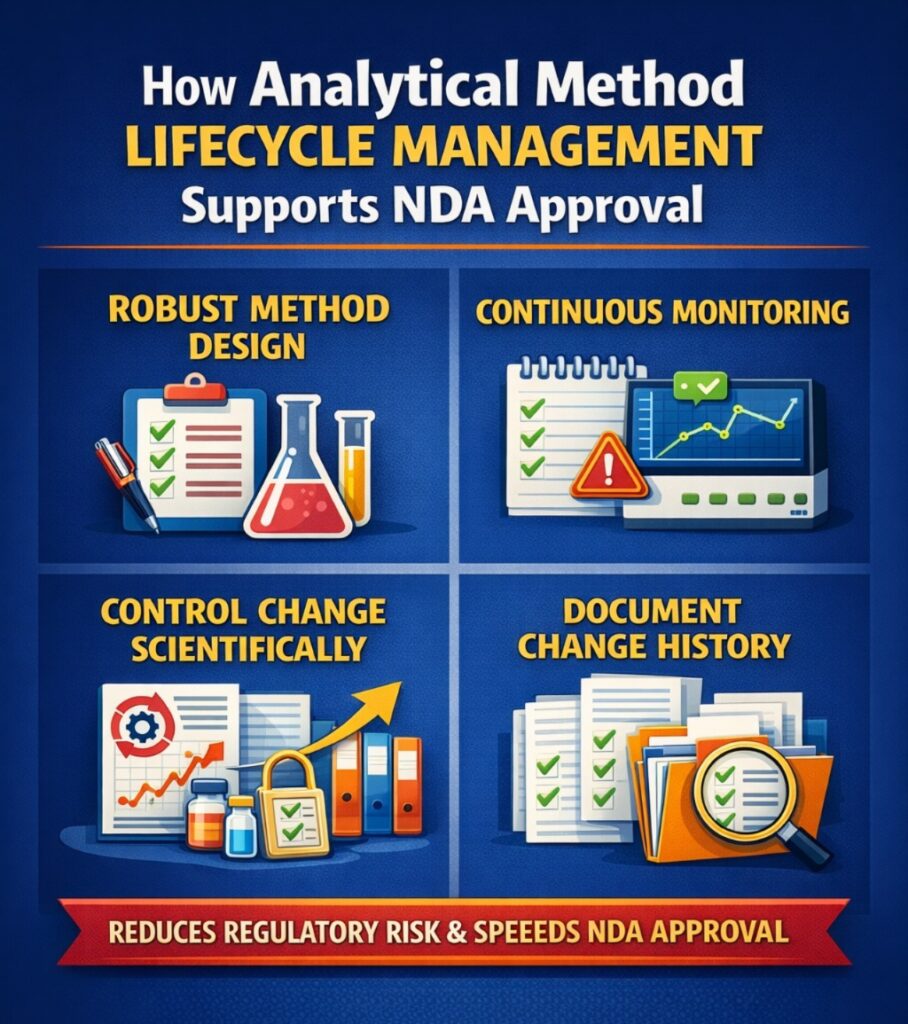
Why Analytical Method Lifecycle CMC Is Now a Competitive NDA Advantage
Analytical Method Lifecycle CMC is no longer optional. It has become a competitive advantage for faster NDA approvals and stronger regulatory confidence.
Organizations that adopt lifecycle thinking respond more quickly to FDA questions, avoid late-stage remediation, and reduce post-approval commitments.
They also build long-term regulatory trust by demonstrating scientific discipline and quality maturity.
FDA confidence is based on quality of control, not the volume of submitted data.
Conclusion
Analytical Method Lifecycle CMC directly supports NDA approval by ensuring analytical methods are robust, defensible, and sustainable throughout commercial use. It connects development, validation, and routine testing into one consistent framework.
In the current regulatory landscape, NDA success depends on long-term method performance rather than single-point validation. Companies that embed Analytical Method Lifecycle CMC into their strategy experience fewer IRs, smoother inspections, and faster approvals.
Need Expert Support with Analytical Method Lifecycle CMC?
If you are preparing for an NDA or strengthening your CMC strategy, connect with experts who deeply understand FDA expectations:
Frequently Asked Questions (FAQs)
Analytical Method Lifecycle CMC helps shorten NDA approval timelines by reducing uncertainty during FDA review. When methods are well understood, monitored, and justified, reviewers need fewer clarifications. This leads to fewer Information Requests and smoother review cycles. Overall, it supports faster and more predictable approvals.
FDA focuses on lifecycle management because it shows how a method performs over time, not just at one validation point. Continuous monitoring provides confidence that results remain reliable during routine use. Re-validation alone cannot demonstrate long-term control. Lifecycle management better reflects real-world method performance.
Yes, weak lifecycle control can contribute to a CRL if FDA questions the reliability of analytical data. Issues like unexplained variability, weak robustness, or unclear change history raise regulatory concerns. These gaps can delay approval significantly. Strong lifecycle practices help prevent such outcomes.
Analytical Method Lifecycle CMC reduces post-approval commitments by addressing risks early. When methods are already well controlled and monitored, FDA is less likely to request additional studies after approval. This leads to fewer regulatory obligations later. It also supports smoother lifecycle management post-launch.
Methods linked directly to patient safety and product quality receive the most attention. These include impurity methods, stability-indicating assays, potency tests, and bioassays. FDA closely reviews their robustness and long-term performance. Lifecycle control is especially critical for these methods.
Yes, FDA expects legacy methods included in an NDA to demonstrate adequate lifecycle control. Even older methods must show ongoing performance monitoring and risk management. Lack of lifecycle evidence can trigger questions. Applying lifecycle principles strengthens legacy method acceptance.
Reference
- Popkin, M. E., Goese, M., Wilkinson, D., Finnie, S., Flanagan, T., Campa, C., Clinch, A., Teasdale, A., Lennard, A., Cook, G., & Mohan, G. (2022). Chemistry manufacturing and controls development, industry reflections on manufacture, and supply of pandemic therapies and vaccines. AAPS Journal, 24(6), Article 101. https://www.ncbi.nlm.nih.gov/pmc/articles/PMC9514697/
- Patel, D. H., Kumar, B. J., & Patel, A. A. (2017). Preparation and review of chemistry, manufacturing and control (CMC) sections of CTD dossier for marketing authorization. International Journal of Drug Regulatory Affairs, 5(2), 1–12. https://www.ijdra.com/index.php/journal/article/view/196
- U.S. Food and Drug Administration. (2024, November 19). Chemistry manufacturing and controls (CMC) guidances for industry (GFIs) and questions and answers (Q&As). U.S. Department of Health and Human Services. https://www.fda.gov/animal-veterinary/guidance-industry/chemistry-manufacturing-and-controls-cmc-guidances-industry-gfis-and-questions-and-answers-qas
Get In Touch With Us
About The Author