🔍 Summary: Key Takeaways for Managing CMC Risk
- Early-stage drug development faces critical CMC-related risks that can derail clinical and regulatory timelines.
- Proactive CMC risk management ensures data integrity, process robustness, and regulatory alignment.
- Critical areas include analytical method validation, raw material variability, formulation robustness, and technology transfer.
- Early Quality by Design (QbD), risk-based planning, and cross-functional collaboration are essential.
- Leveraging predictive analytics and early regulatory consultation improves decision-making.
- Avoiding pitfalls in CMC can significantly accelerate IND-enabling timelines and reduce cost and compliance risks.
Introduction: Why Managing CMC Risk Matters in Early Drug Development
In the early stages of drug development, making the right choices around manufacturing and controls is critical. Surprisingly, many regulatory setbacks are caused by CMC deficiencies, not safety or efficacy concerns. Inconsistent manufacturing, incomplete documentation, and weak quality systems are frequent problems that can lead to delays or clinical holds.
Early development is often fast-paced and uncertain, with limited data and evolving processes. Despite these challenges, decisions made during this time have long-term consequences. Ignoring or underestimating CMC risk can lead to major problems like failed batches, reformulations, or repeat toxicology studies—all of which increase cost and delay progress.
A structured approach to managing CMC risk ensures your early development work aligns with future regulatory expectations and supports smoother transitions into later stages.
Explore Our Full Range of Services: Chemistry, Manufacturing, and Controls (CMC) Services
🧪 Key CMC Risks in Early Development
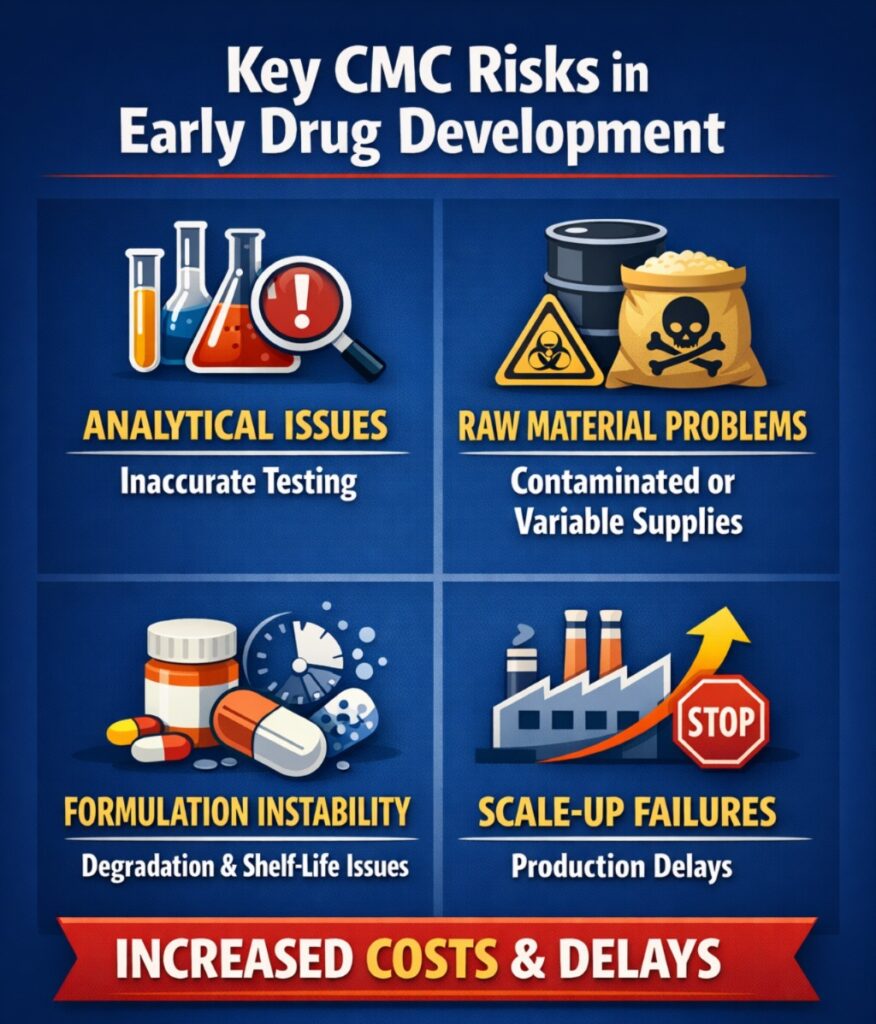
During early drug development, several CMC risks need to be actively identified and managed. These risks arise from scientific uncertainty, limited resources, and changing processes. The following table outlines the most critical categories and their potential impacts:
| CMC Risk Category | Description | Potential Impact |
|---|---|---|
| Analytical Variability | Immature methods, lack of validation | Inaccurate data, submission rejection |
| Raw Material Variability | Poor supplier control or grade selection | Batch failure, inconsistent product |
| Formulation Instability | Unoptimized dosage forms | Degradation, toxicity, bioavailability issues |
| Scale-Up Failures | Non-scalable lab processes | Process bottlenecks, delays |
| Regulatory Misalignment | Incomplete or inappropriate CMC submissions | Refuse-to-file, clinical hold |
| Tech Transfer Gaps | Insufficient process knowledge during CDMO transfer | Batch failure, QA/QC gaps |
| Inadequate Stability Data | Limited accelerated or real-time studies | Clinical delays, shelf-life errors |
Each of these categories directly affects product quality, patient safety, and regulatory confidence. Identifying and reducing these risks early creates a more stable and predictable development path.
Learn How to Avoid Common Pitfalls: Addressing CMC Deficiencies in IND & NDA Submissions
🧭 Strategies for Managing CMC Risk in Early Development
The best way to avoid issues is to plan ahead. A proactive risk management approach helps you prevent problems instead of reacting to them later. This strategy combines science, quality systems, and regulatory knowledge to guide early decisions and reduce risk over time.
✅ 1. Build an Early CMC Risk Assessment Framework
Start by creating a formal risk register that follows ICH Q9 principles. This tool helps teams document, assess, and prioritize risks based on their likelihood and potential impact. High-risk areas—like raw materials or formulation stability—can then be addressed early on.
The risk register should be updated regularly as new data becomes available or processes evolve. It’s not a one-time task, but a living document that keeps your development aligned and informed.
Optimize Your Early-Stage Path: Strategic IND CMC Services for Early Development
✅ 2. Develop Fit-for-Purpose Analytical Methods
In early development, analytical methods don’t need to be fully validated for commercial use—but they do need to be reliable. Focus on designing methods that are simple, specific, and stability-indicating. Avoid over-engineering at this stage, as it wastes resources and limits flexibility.
A phased analytical strategy, aligned with ICH Q14, ensures your methods evolve smoothly as your product moves from preclinical to clinical stages.
Strengthen Your Data Integrity: Analytical Method Development for IND and NDA
✅ 3. Control Raw Material and Excipient Risks Early
Material quality can make or break your batches. That’s why it’s important to source from GMP-compliant suppliers as early as possible. Using pre-qualified raw materials with clear impurity profiles and known safety status helps reduce surprises during scale-up.
Document your material control strategies in the Quality Target Product Profile (QTPP). This promotes traceability and simplifies future regulatory reviews.
Master Your Starting Materials: Comprehensive Drug Substance CMC Management
✅ 4. Apply Quality by Design (QbD) Principles Early
Using QbD early in development leads to a better understanding of how formulation and process variables affect your product. Define your Critical Quality Attributes (CQAs) and Critical Process Parameters (CPPs) during preclinical batches whenever possible.
Design of Experiments (DoE) is a valuable tool for identifying formulation sensitivity and process robustness. Track your decisions and outcomes using knowledge management tools to support long-term control strategies.
Identify and Control Risks: Impurity Profiling and Management in CMC
✅ 5. Prepare for Technology Transfer from the Start
Tech transfer is one of the most common points of failure in early CMC work. Planning for it from day one helps you avoid major setbacks later. Work with CDMOs that have proven experience in early-phase manufacturing.
Start developing your Technology Transfer Package (TTP) early. This includes master batch records, analytical methods, and specifications. Also, set up clear quality agreements that define roles, responsibilities, and how risks will be managed between partners.
Find the Right Partner: Specialized CMC CRO Services for Virtual and Biotech Firms
🧠 Digital Tools for Managing CMC Risk
Digital transformation is changing how companies manage risk. Modern tools can identify patterns and predict problems before they happen. For example, multivariate analysis (MVA) can detect small shifts in processes that might otherwise go unnoticed.
Stability modeling tools like ASAPprime® use minimal data to predict product shelf life. Meanwhile, machine learning platforms analyze historical and real-time data to flag scale-up risks. Cloud-based quality management systems improve collaboration, audit readiness, and document control.
These technologies enhance decision-making and reduce the need for reactive fixes.
Ensure Long-Term Quality: Stability Studies and Shelf-Life Prediction in CMC
🧬 Regulatory Strategies to Reduce CMC Risk
Early conversations with regulators can greatly reduce risk. Scheduling a pre-IND meeting with a clear CMC strategy builds trust and aligns your development with expectations.
Your submission should follow FDA guidance for Phase I trials and include comparability protocols, method limitations, and clear scientific justifications. Open communication with regulators can prevent costly delays and misinterpretations.
Understand the Review Process: Inside the FDA CMC Review and Approval Process
🔁 Common Mistakes in Managing CMC Risk (and How to Avoid Them)
Mistakes to avoid:
- Using R&D-grade materials for clinical manufacturing.
- Overlooking interactions between excipients and active ingredients.
- Postponing stability studies until after toxicology batches.
- Assuming small-scale processes will scale up without issues.
How to avoid them:
- Treat early-phase materials with commercial-level care.
- Conduct forced degradation and compatibility studies early.
- Engage with CDMOs early to ensure process scalability.
- Involve CMC experts in regulatory planning from the start.
🏁 Conclusion: The Value of Managing CMC Risk Early
Investing in managing CMC risk during early-stage development pays off in many ways. It lowers the chances of failure, reduces regulatory roadblocks, and helps keep your program on time and within budget.
Strong CMC practices lead to faster IND approvals, smoother clinical trials, and better investor confidence. By combining smart planning, digital tools, and early regulatory engagement, you can significantly reduce risk and improve outcomes.
A proactive CMC approach positions your drug development program for long-term clinical and commercial success.
Contact ResolveMass for Expert CMC Guidance
Need expert help managing CMC risk for your preclinical or Phase I program?
📞 Contact our team today.
Expert FAQs on Managing CMC Risk
One of the most common and underestimated CMC risks is variability in analytical methods. If methods are not properly developed or qualified, the data generated may be unreliable, leading to regulatory delays. Formulation instability also poses a significant challenge as it can affect product performance and patient safety.
CMC risk should be evaluated as early as the preclinical stage—ideally before GLP toxicology batches are manufactured. Starting early allows development teams to identify potential issues in materials, methods, and processes and to build a strategy that supports long-term scalability and compliance.
Several tools can support effective CMC risk management. These include formal risk registers, design of experiments (DoE), stability modeling software, and predictive analytics platforms. Together, they allow teams to anticipate problems, prioritize actions, and make informed decisions based on real data.
Quality by Design (QbD) helps reduce CMC risk by identifying how specific material attributes and process parameters affect final product quality. This approach minimizes trial-and-error work, enhances process understanding, and creates a more robust development pathway that can adapt over time.
A qualified CDMO (Contract Development and Manufacturing Organization) plays a key role in reducing CMC risk by bringing expertise in early-stage manufacturing and regulatory expectations. Their involvement ensures smoother scale-up, better documentation, and fewer surprises during tech transfer.
Yes, unresolved CMC issues are a frequent cause of clinical trial delays. Inadequate data on materials, processes, or stability can lead to a refusal-to-file or even a clinical hold, both of which can significantly impact timelines and increase development costs.
Reference
- Patel, D. H., Kumar, B. J., & Patel, A. A. (2017). Preparation and review of chemistry, manufacturing and control (CMC) sections of CTD dossier for marketing authorization. International Journal of Drug Regulatory Affairs, 5(2), 1–12. https://www.ijdra.com/index.php/journal/article/view/196
- U.S. Food and Drug Administration. (2024, November 19). Chemistry manufacturing and controls (CMC) guidances for industry (GFIs) and questions and answers (Q&As). U.S. Department of Health and Human Services. https://www.fda.gov/animal-veterinary/guidance-industry/chemistry-manufacturing-and-controls-cmc-guidances-industry-gfis-and-questions-and-answers-qas
Get In Touch With Us
About The Author